- National Academic Conference Commemorating the Designation of the Birthplace of Holy Teacher Jeungsan Kang Il-sun as a Religious Cultural Heritage of Jeonbuk “The Sangsaeng Thought of Resolution of Grievances and Grateful Reciprocation of Favors: From the Center of Modern Korean Thought to World Thought”
- 2025-07-06
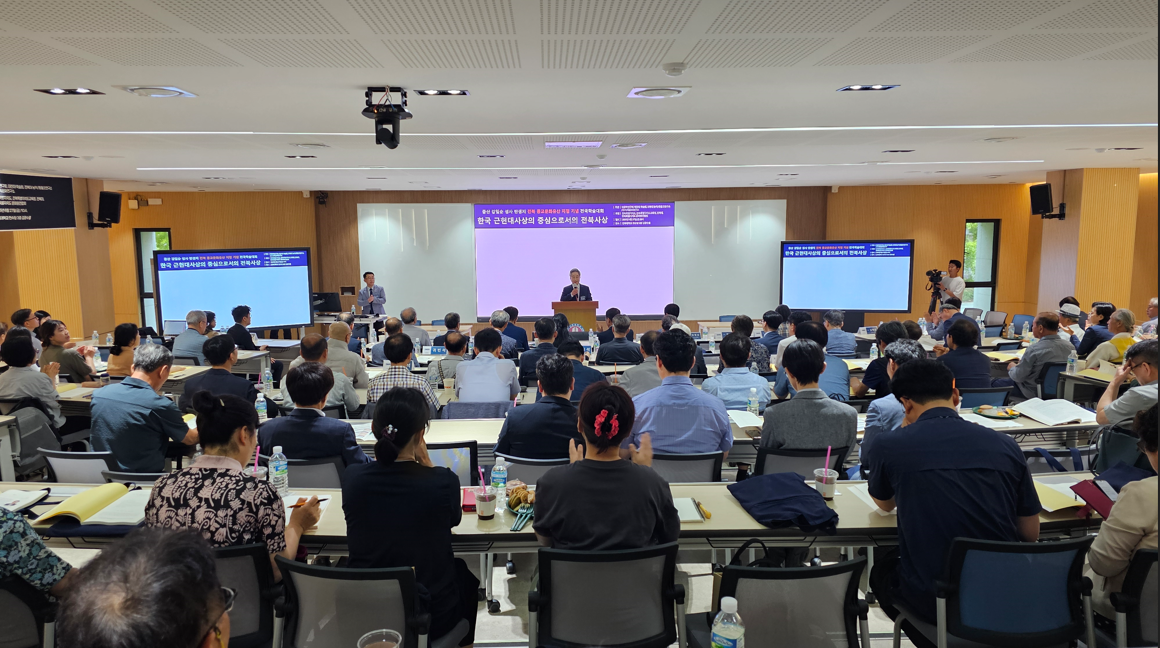
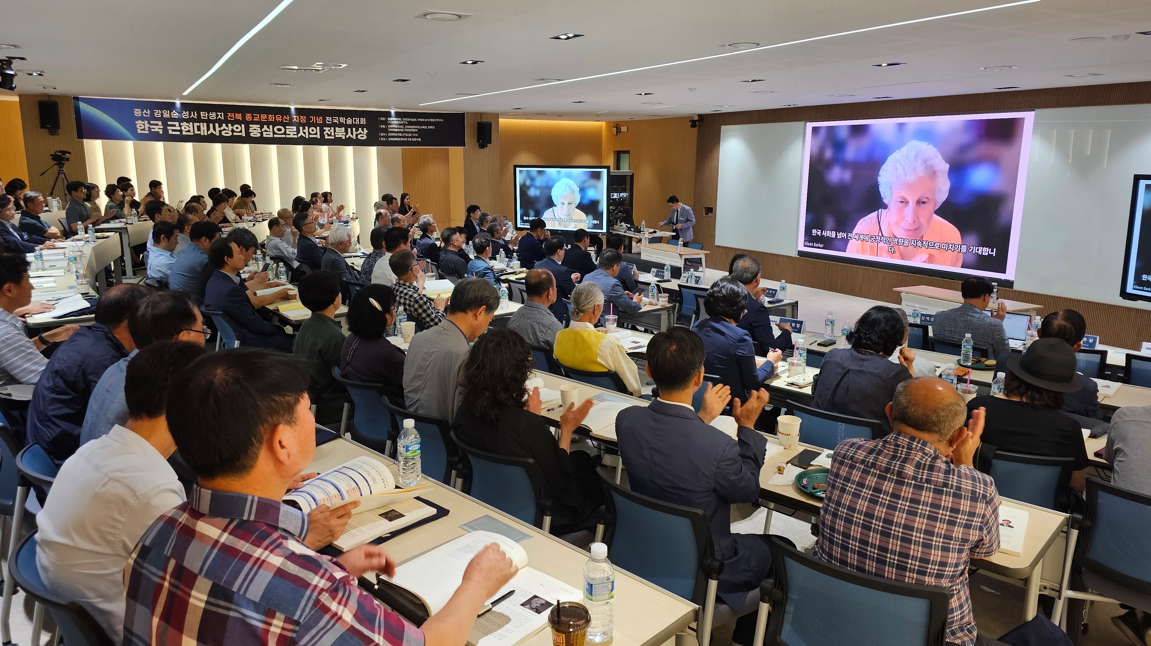
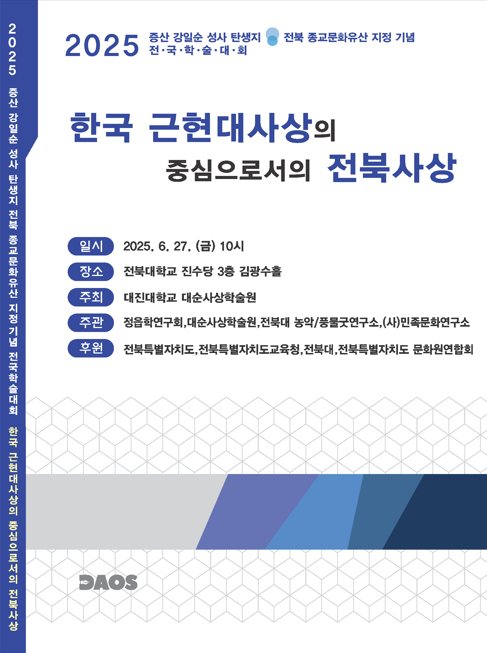
On June 27th, a national academic conference commemorating the designation of the birthplace of Holy Teacher Jeungsan as a religious cultural heritage was successfully held at Kim Kwang-su Hall in Jinsudang, Jeonbuk National University. The event was attended by over 200 distinguished guests from various fields. Under the theme “Jeonbuk Thought as the Center of Modern Korean Thought,” the conference was hosted by the Daesoon Academy of Sciences (Chairman Bae Kyu-Han) of Daejin University and co-organized by several academic institutions, including the Jeongeup Academy Research Group. It was supported by Jeonbuk State, the Jeonbuk State Office of Education, Jeonbuk National University, and the Jeonbuk Federation of Cultural Centers.
During the conference, notable figures including Kim Kwan-young (Governor of Jeonbuk State), Moon Seung-woo (Chairman of the Jeonbuk State Council), Yang O-bong (President of Jeonbuk National University), and Eileen Barker (Professor Emeritus at the London School of Economics) delivered congratulatory remarks. They celebrated the designation of Holy Teacher Jeungsan's birthplace as a religious cultural heritage of Jeonbuk State and emphasized the global significance of his The Grateful Reciprocation of Favors for Mutual Beneficence (Boeun-Sangsaeng) philosophy, rooted in Resolution of Grievances (Haewon) and Grateful Reciprocation of Favors (Boeun).
The birthplace was first designated as a "Local Cultural Heritage of Jeongeup" on May 14, 2021, and was elevated to a "Religious Cultural Heritage of Jeonbuk State" in October 2024. This conference was organized to commemorate this milestone. Major media outlets, including KBS, JTV, Chosun Ilbo, and JoongAng Ilbo, covered the event. The keynote presentations highlighted not only the historical and cultural value of the birthplace but also provided a modern reinterpretation of Holy Teacher Jeungsan’s life and thought. It served as a meaningful platform to seek a shift in perception and a spirit of the times that could lead today’s world—marked by conflict and mutual contention—toward reconciliation and Mutual Beneficence (Sangsaeng).
The conference was conducted in three parts. In Part 1 (Keynote Presentations, chaired by Prof. Na Jong-woo), Professor Kim Ik-doo (Jeonbuk National University) interpreted Jeungsan’s thought as a philosophy of "Resolution of Grievances, Mutual Beneficence, and Great Unity (Daedong)," encompassing Western, Northern, Eastern, and Southern Learning. Chairman Bae Kyu-Han (Daejin University) and Dr. Heo Jeong-ju (Jeonbuk National University) proposed specific plans for the restoration and utilization of the birthplace, offering multi-faceted policy suggestions for the future of religious cultural heritage. Professor Cha Sun-geun (Daejin University) highlighted the transformative meaning of Jeungsan’s practical "Gaebyeok" (Great Opening) thought as a religious movement. He argued that Jeungsan’s thought, philosophy, and religion represent the most quintessential "K-Thought, K-Philosophy, and K-Religion," receiving high praise from the audience.
Part 2 (Thematic Presentations, chaired by Prof. Jung Jae-seo) summarized the historical flow of Jeonbuk thought, reconstructing the lineage of regional thinking prior to the emergence of Jeungsan’s thought. It revealed that various traditions—from the Pungryudo of the Three Kingdoms period to the Seon-Gyo integration of Baegun Gyeonghan in the Goryeo Dynasty, and the Silhak and Donghak of the Joseon Dynasty—served as the foundation for Jeonbuk thought. Specific presentations were given by Prof. Choi Young-seong (Korea National University of Cultural Heritage), Prof. Park Kwang-yeon (Dongkuk University), Prof. Cho Young-mi (Dongkuk University), Prof. Kim Baek-nyeong (Chuncheon National University of Education), Prof. Choi Il-bum (Sungkyunkwan University), and Prof. Ahn Shin (Pai Chai University, President of the Korean Association for the History of Religions).
Part 3 (Comprehensive Discussion, chaired by Prof. Choi Young-chan) featured in-depth debates with designated discussants such as Prof. Ahn Hu-sang (Chonnam National University) and Prof. Kim Seong-hwan (Kunsan National University). They discussed the universality of Jeungsan thought as a spirit of the times and its potential to develop into a global philosophy.
This conference served as an academic milestone, proving that Holy Teacher Jeungsan’s thought has played a central role as a convergent horizon for modern Korean thought. Regarding the birthplace, participants suggested that it should function not only as a religious sanctuary but also as a complex cultural space through projects such as "Sangsaeng Pilgrimage Routes," cultural experience content, and regional history education programs, thereby serving as a hub for regional revitalization.
Chairman Bae Kyu-Han stated, "This conference academically proves that Jeonbuk is not merely a regional base for thought but a central axis of modern Korean thought and a fertile ground for intellectual convergence and creation. It is a meaningful time to suggest the possibility of Jeonbuk thought becoming a universal spirit of the times that the global community can empathize with." He added, "In particular, this will be a platform to solidify the cultural-historical significance and global philosophical value of the designation of Holy Teacher Jeungsan’s birthplace as a religious cultural heritage."
President Kim Ik-doo remarked, "As a modern Korean thought, 'Resolution of Grievances, Mutual Beneficence, and Great Unity' is a convergent horizon that responds to social challenges such as division, conflict, and the loss of community. It is a practical philosophy that offers specific ways to lead our society and the future world toward a better place."