- Expanding the Outer Horizons of Daesoon Thought Studies: From Religious Reflections in the AI Era to the Globalization of Jeon-gyeong (the Canonical Scripture)
- 2026-07-20
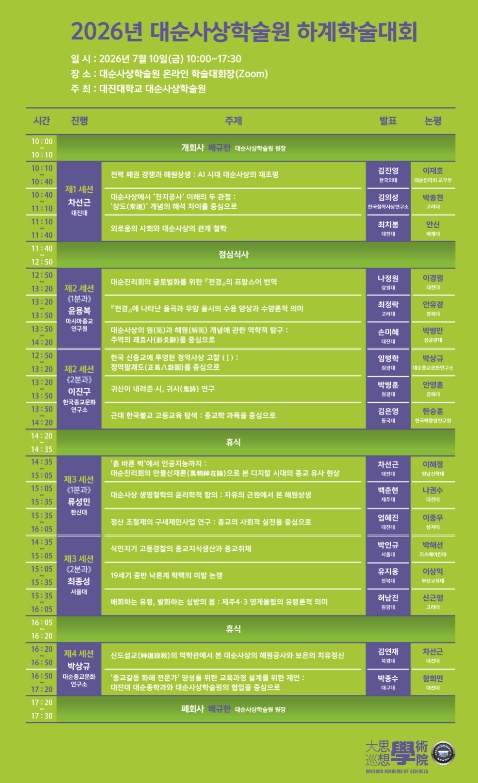
The Summer Academic Conference 2026 of the Daesoon Thought Research Institute was held on Friday, July 10, in a hybrid online and offline format at the International Conference Room of Daejin Education Hall at Daejin University. Prominent scholars in religious studies, including Professors Ryu Seong-min (Hanshin Univ.), Choi Jong-seong (Seoul National Univ.), Lee Jin-goo (Korea Institute for Religion and Culture), and Yun Yong-bok (Asia Religious Institute), chaired each session. Researchers from across the nation attended to exchange presentations and critiques, engaging in heated academic dialogues.
In-depth interdisciplinary papers were presented, including "Power Hegemony Competition and Haewon Sangsaeng (Resolution of Grievances for Mutual Beneficence): Re-illuminating Daesoon Thought in the AI Era" (Prof. Kim Jin-young, Hankuk Univ. of Foreign Studies), "French Translation of Jeon-gyeong (the Canonical Scripture) for the Globalization of Daesoon Jinrihoe" (Prof. Na Jeong-won, Kangwon National Univ.), and "From 'Mud-Plastered Walls' to Artificial Intelligence: Religion-like Phenomena in the Digital Era Viewed Through Daesoon Jinrihoe's Pan-Spiritualism (萬物神+在論)" (Prof. Cha Seon-keun, Daejin Univ.). Discussions actively expanded the outer horizons of Daesoon Thought and multidisciplinary convergence research, ranging from the role of religion in artificial intelligence civilization to the globalization of Jeon-gyeong (the Canonical Scripture), Yihak (I Ching studies) and cultivation theory, and Korean religious history. Additionally, topics linked with social practice drew attention, such as research on Jeju 4·3 rituals and educational curriculum proposals for training 'religious conflict reconciliation experts.'
In the closing remarks, the Director of the Institute emphasized that "In an era when artificial intelligence reshapes and changes human life, it is more essential than ever to academically elucidate the values of healing and reconciliation inherent in the teachings of Haewon Sangsaeng." He expressed expectation that "today's achievements will broaden the horizons of Daesoon Thought research and convergent academic research, leading to an intellectual asset that reflects upon the conflicts faced by our society."